Our Business Strategy
Based on the Philippine jurisdictional roadmap for the adoption of international sustainability standards last July 2024, it is envisioned that all publicly-listed and non-listed large corporations will embrace the new rules.19 The Philippine Securities and Exchange Commission (SEC) is likewise campaigning for small and medium enterprises to adopt sustainability in due time.20 Both moves are aimed at building resilience and the adaptive capability of businesses due to the deteriorating environment.
The evolving regulatory landscape requires companies to prepare and to be clear on their roles as sustainability becomes universal for all sizes of enterprises. Thus, our strategy focuses on the role of FPH as a parent company in supporting our portfolio companies not only to adjust to the challenging operating environment but to thrive and soar. With adequate backing from FPH, the main responsibility of our subsidiaries is to chart their growth so they can create values for their respective internal and external stakeholders. Through collaboration with our subsidiaries, we will deliver the FPH’s ultimate value of contributing to the restoration of the planet’s and the people’s health in our areas of influence.
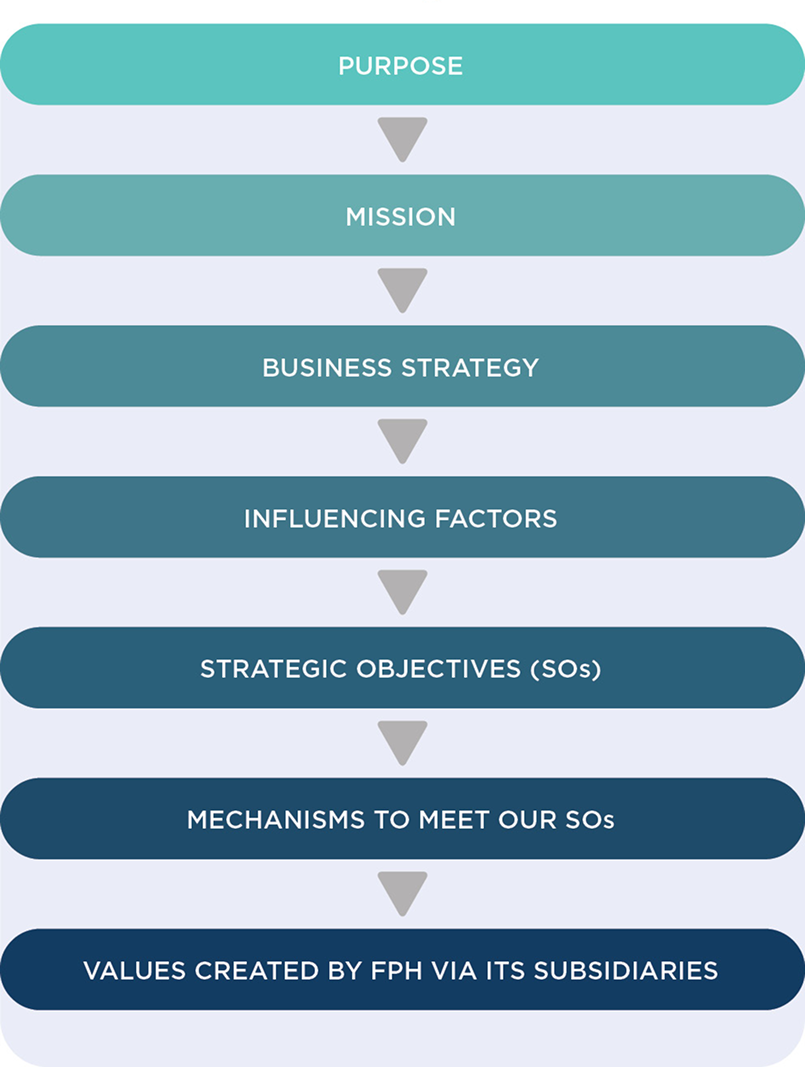
▸ our business strategy as guided by our purpose and mission;
▸ factors influencing the strategy and its execution;
▸ the ensuing strategic objectives;
▸ the mechanism to deliver the strategy;
▸ our business model, and
▸ the resilience to the company brought about by our strategy so subsidiaries can create values for their respective stakeholders.
Our Strategic Path
Elements of our Business Strategy
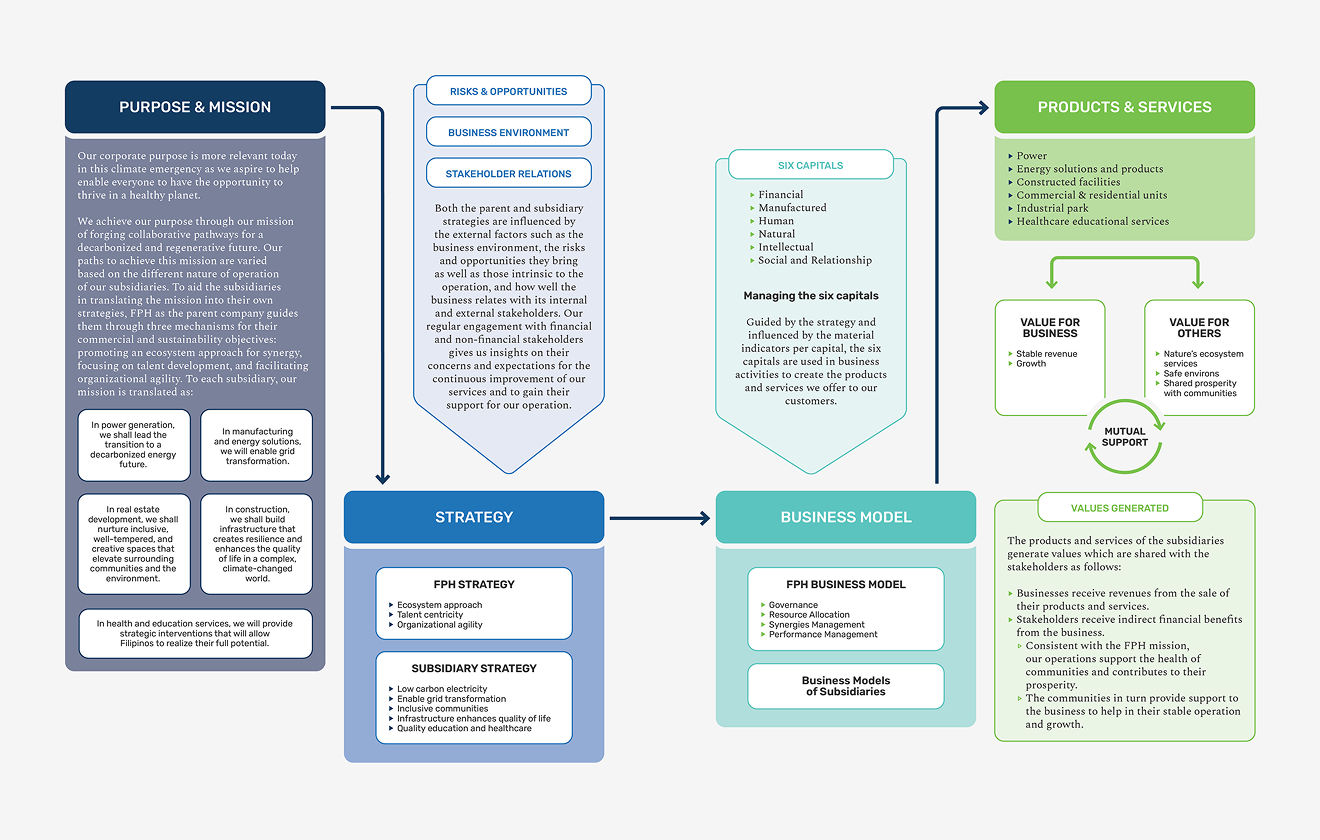
Our business strategy is based on our purpose “To empower everyone to have the opportunity to thrive in a healthy planet” and we execute this purpose through our mission “To forge collaborative pathways for a decarbonized and a regenerative future”.
At the parent level, we assist our subsidiaries meet their ambitions through our 3-pronged business strategy:

Ecosystem and systemic approach

Talent Centricity

Organizational Agility
Factors Influencing our Business Strategy
We ensure that our business strategy aligns with our decarbonization mission being climate-centric (in particular) and regenerative elements are ESG-centric (in general), while also being mission driven and attuned to the needs of the times. Our force multiplier is our workforce, which is guided by our strategic objectives of synergy and talent centricity.
Our businesses had three top risks in 2024 and we mobilized key measures to minimize their impacts on our strategy and its execution. The details of the risks and opportunities of our portfolio are discussed in the Risk Management section of the report, on pages 114-121.
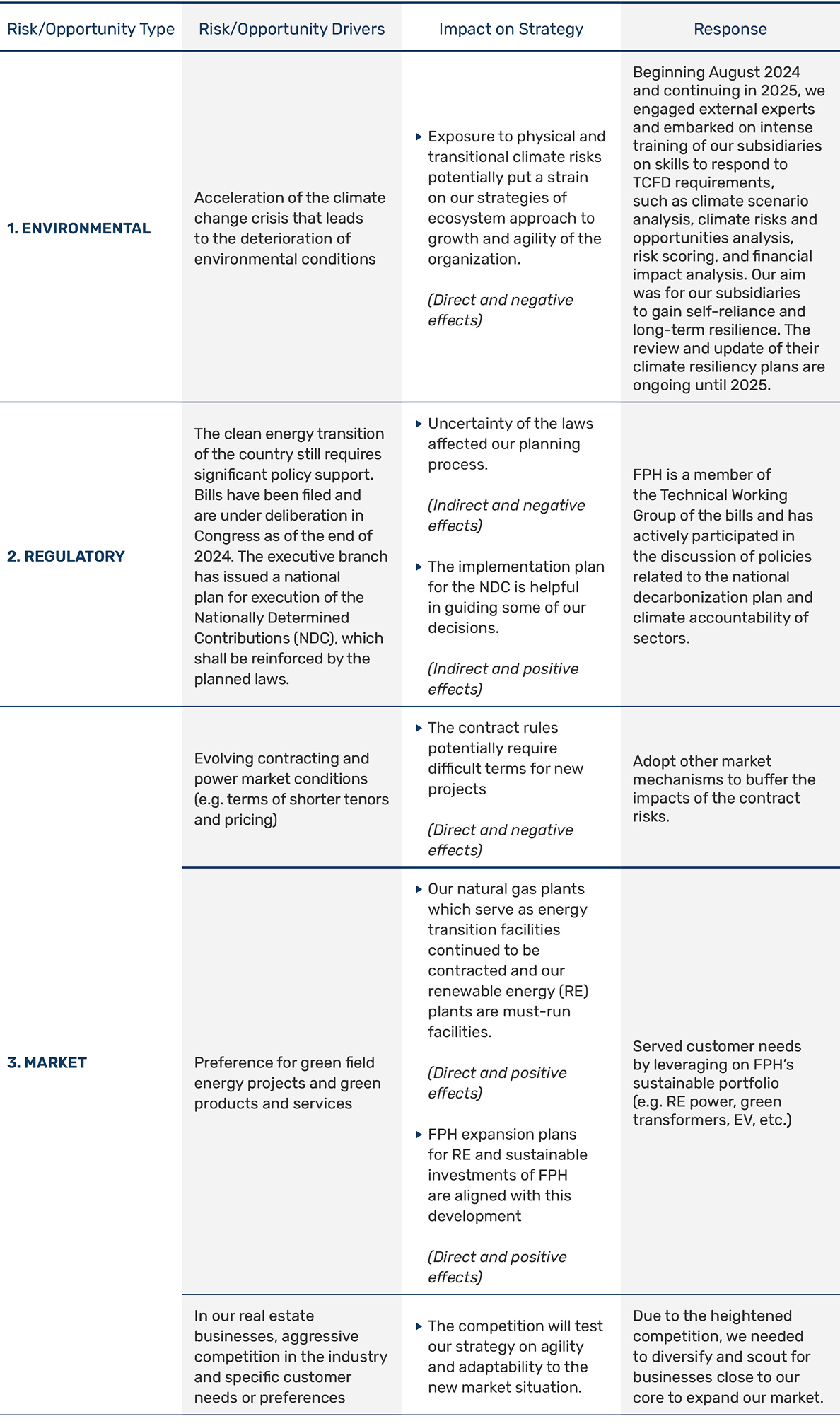
We also reviewed our strengths and weaknesses as we prepared to meet the challenges of our operating environment to ensure we can deliver on our long-term strategy. In summary:
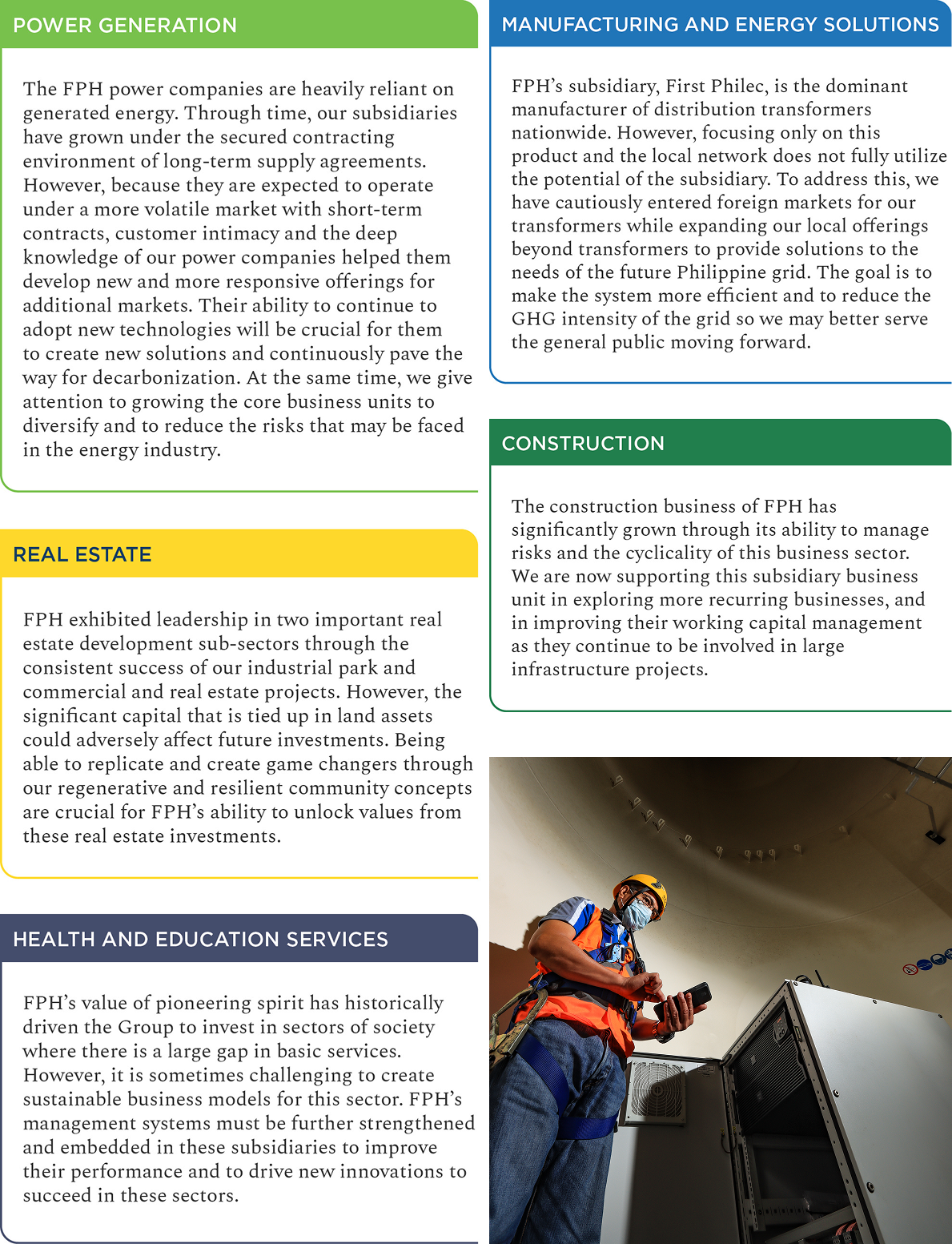
Our Strategic Objectives and Priorities
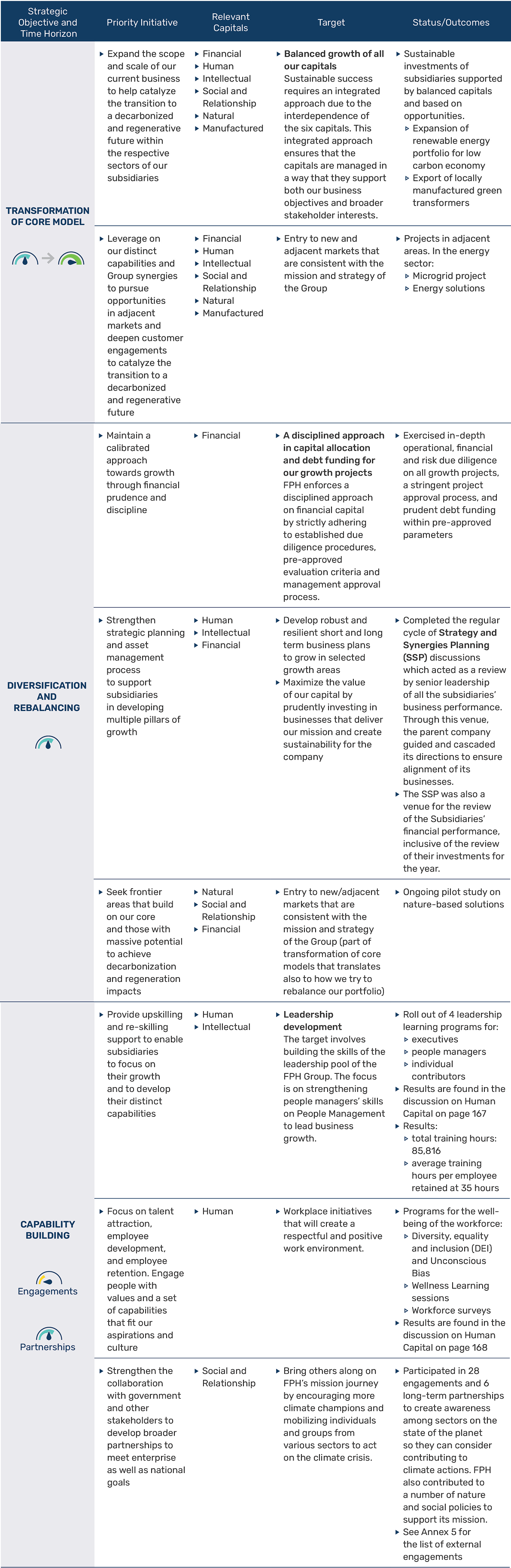
FPH’s Strategic Objectives were identified through a series of management discussions and strategic planning workshops of the top management and key executives. The long-term blueprint (approved by the FPH Board on February 3, 2023) was reviewed in 2024, and was confirmed to remain unchanged. These strategic objectives are expected to be reinforced in the years to come. The FPH strategic objectives include:
▸ Diversification and Rebalancing
▸ Transformation of Core Models
The strategic objectives and initiatives must be coupled with innovation, as there will always be challenges that will be faced by our customers and our markets. We recognize that it is only through innovative solutions that we can contribute to the decarbonization of our planet and to the regeneration of our economy and society. Innovation therefore is critical to the execution of the FPH mission. We place the formidable challenge upon ourselves to become problem solvers and innovators as we pursue our long-term growth.
The following are our strategic objectives, priority initiatives for desired outcomes, corresponding targets, and their status:

Mechanism to Meet our Strategic Objectives
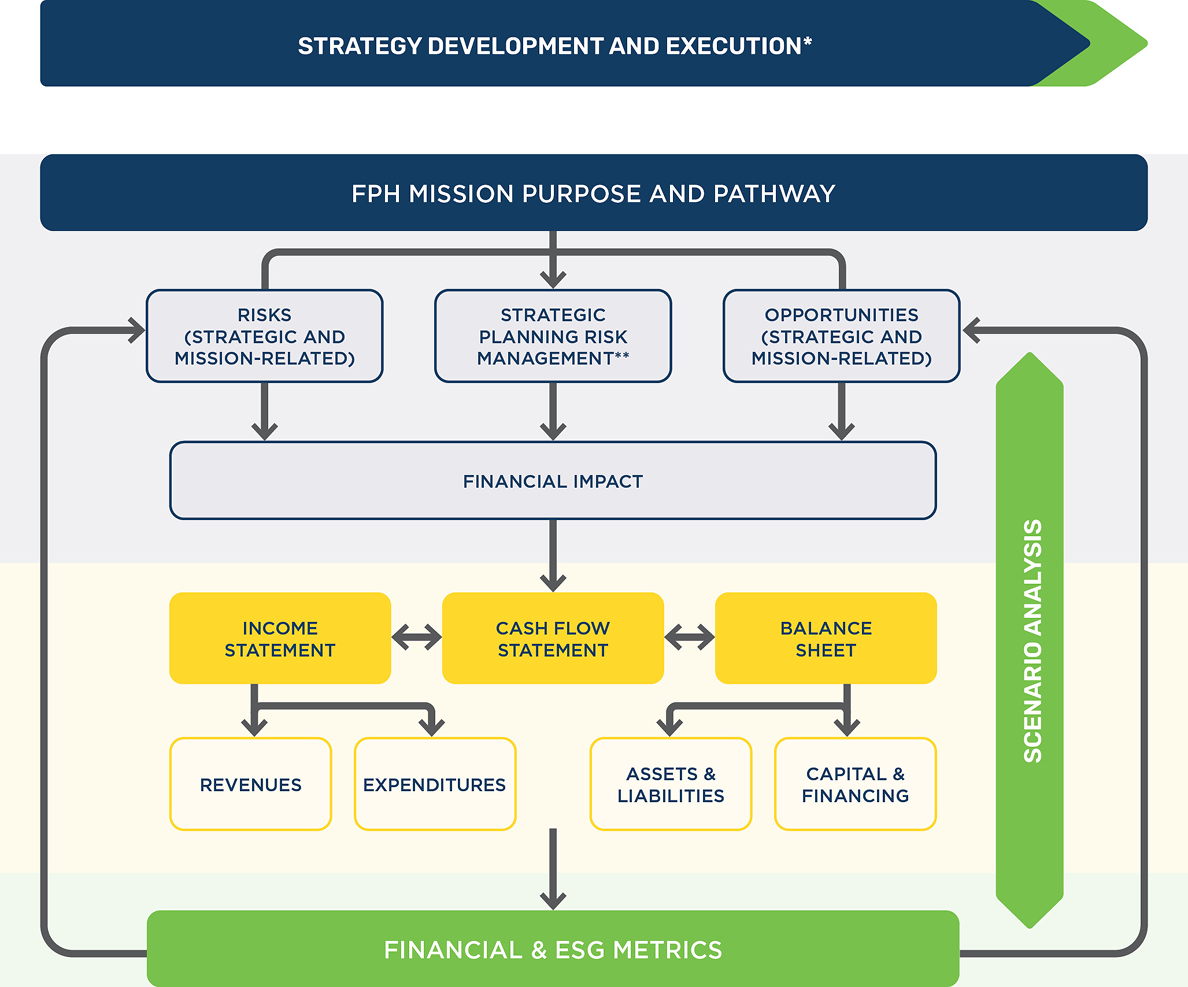
FPH’s overall strategy planning process is characterized by regular dialogues among the various business units, the parent company, and the Board of Directors to ensure that the needs of all our pentad stakeholders are considered. In 2023, the Group initiated the integration and alignment of its key management processes affecting strategy, risk management, sustainability and financial management. This was done to ensure that the organization uses a holistic lens in assessing the external and internal factors that affect the execution of its strategy, while also giving equal focus on financial and non-financial factors that can impact its execution. We have continued to follow these key management processes in 2024.
More information on the evolution of FPH’s Integrated Management Framework are discussed on pages 98-90 of the 2023 Integrated Report.
FPH Business Model
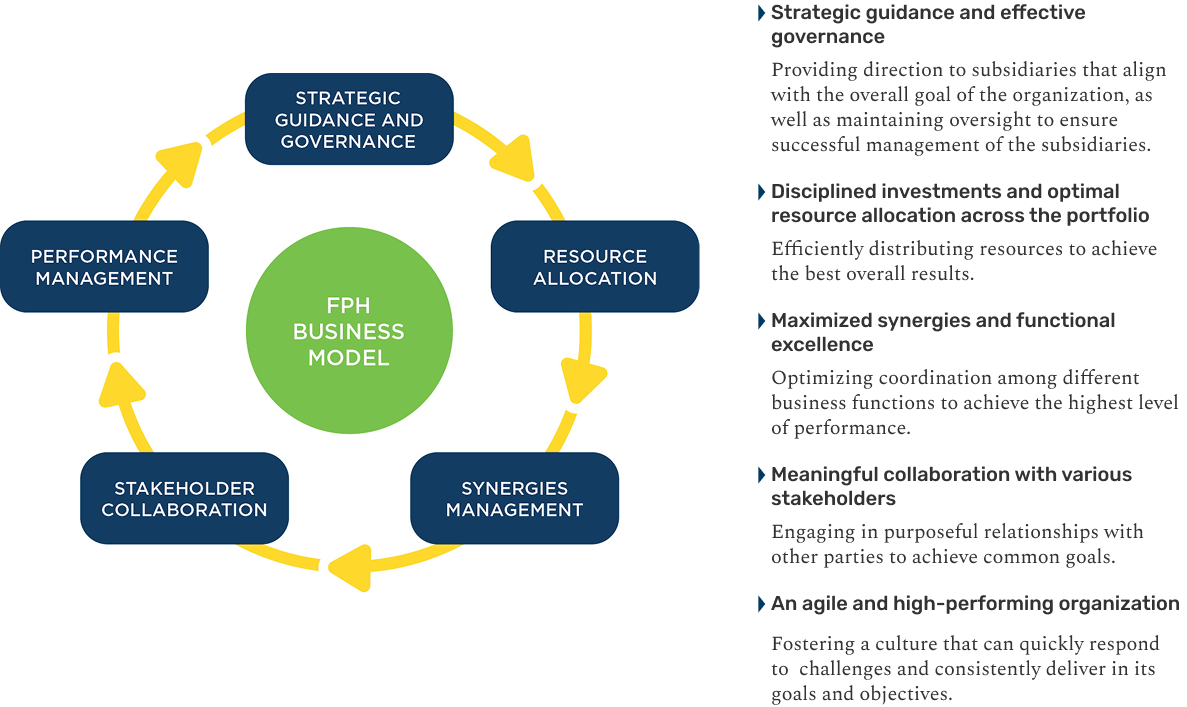
Our business model is composed of activities that transform our capitals into products and services that create value for the stakeholders and the enterprise.
The business model is a set of the following activities of the parent company to shepherd the success of the subsidiaries:
Implications of the Strategy and Business Model on FPH’s Resilience
Our strategic objectives that guide the execution of our business model are also channels of resilience against financial and sustainability risks:
▸Capability Building
Capability building is critical to lower the risks faced by FPH and can enhance the ability of the company to compete effectively. A skillful and agile workforce will respond to issues timely and will develop creative solutions to problems that the company may encounter.
▸Diversification and Rebalancing
Diversification and rebalancing focuses on reducing risks inherent to the business portfolio and improving profitability. FPH can reduce its reliance on a single major revenue source, mitigating the impact of industry-specific downturns to the overall performance. The strategic initiative allows FPH to blaze new trails to evade threats in some areas of operation. A wider range of products and services is aligned with FPH’s mission of building integrated platforms that increase shared value.
▸Transformation of Core Models
The strategic objective strengthens and supports FPH’s ability to avoid obsolescence, innovate and grow in an evolving economic landscape. It is responsive to the needs of the market that FPH subsidiaries choose to serve. By transforming core models, FPH can effectively adapt to changing market conditions and emerging technologies, ensuring long-term sustainability and success as it navigates towards a decarbonized and regenerative future.
How We Create Value